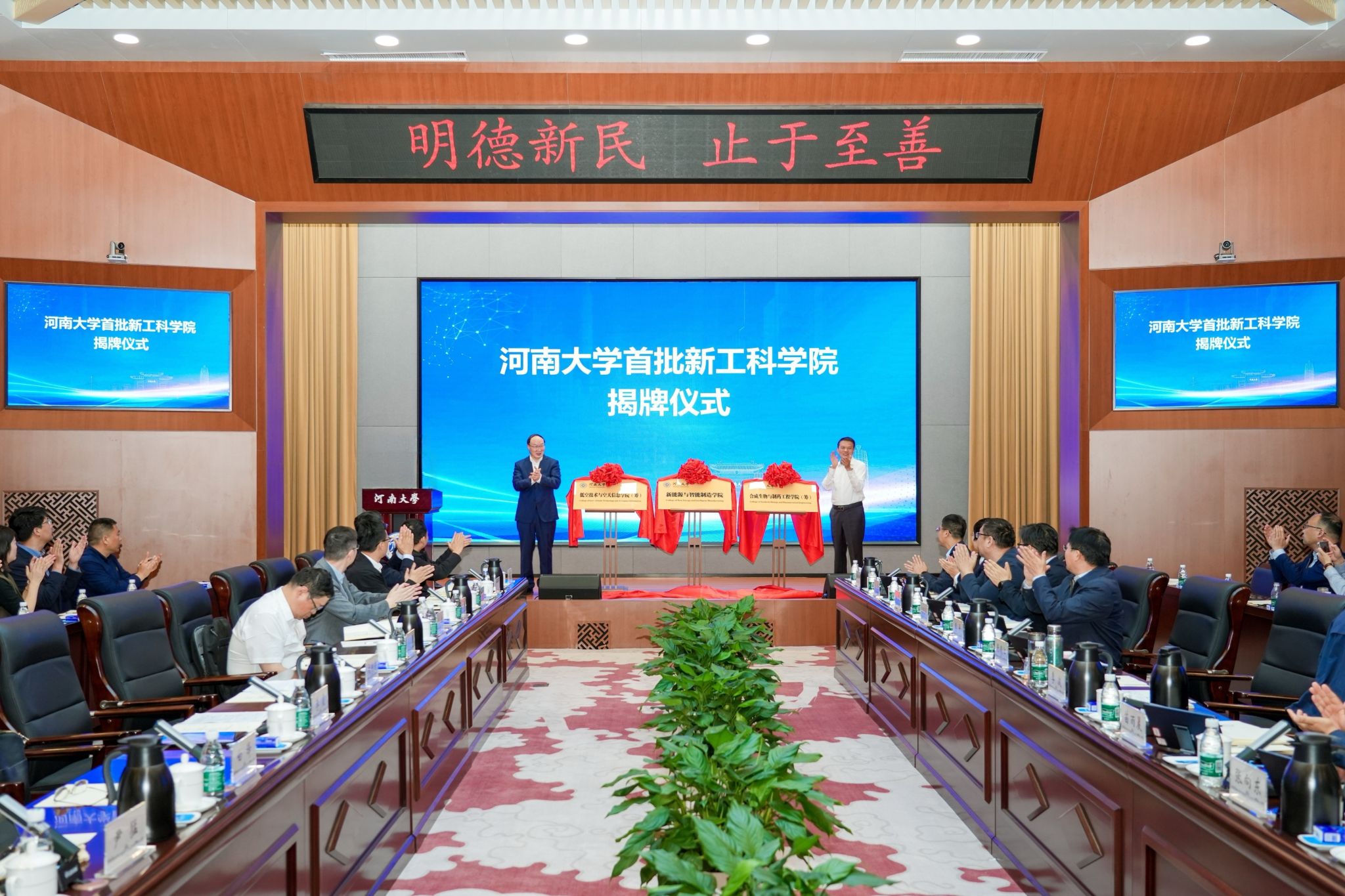
Recently, the inauguration ceremony of Henan University's first batch of new engineering colleges/schools (the College of New Energy and Intelligent Manufacturing, the College of Low-Altitude Technology and Aerospace Information, and the School of Synthetic Biology and Pharmaceutical Engineering) and the work meeting for the second batch selection were held in Conference Room B102, North Building, Youlan Academy, Longzihu Campus, Zhengzhou. All university leaders currently in office, along with the heads of relevant functional departments and colleges/schools, as well as faculty representatives, attended the meeting. Ji Bo, the Party Secretary of the university, presided over the meeting.
President Zhang Suojiang, Academician of the Chinese Academy of Sciences, extended congratulations to the three new engineering colleges/schools and the newly appointed deans and expressed gratitude to all faculty and students who have contributed to the development of emerging engineering education, on behalf of the university. He pointed out that the establishment of the first batch of new engineering colleges/schools marks a milestone in the university's discipline structure encompassing the arts, sciences, engineering, and medicine, and is an important symbol for the transformation and development of the century-old Henan University (HENU). Focusing on the three major questions—"why to develop emerging engineering education, what kind of emerging engineering education to develop, and how to develop it"—he elucidated the significance, goals, and practical pathways for the development of emerging engineering education. He called on all faculty and students to strengthen their convictions, take on responsibilities, and work together to forge a new chapter for the university's emerging engineering education development, making HENU's emerging engineering education an industry benchmark and a distinctive hallmark, and empowering HENU to scale new heights with the strength of emerging engineering education.
Zhang Suojiang emphasized that developing emerging engineering education is an inevitable path to seize opportunities presented by global technological transformation, to gain the initiative in global competition, and to fulfill the mission of serving national strategies, supporting the high-quality development of Henan Province, and building a modern industrial system. It also serves as an important measure to implement the university's main development guideline of "strengthening sciences, revitalizing arts, and advancing emerging engineering education and new medical sciences" and to accelerate its progress toward the "Double First-Class" development. He stressed that emerging engineering education development must adhere to the national demands—building small yet refined, distinctive, and high-level research-oriented colleges/schools. It is essential to resolutely oppose such tendencies as seeking quick success, formalistic practices, fraud and deception, and the trend of engineering disciplines becoming overly scientific in nature. HENU should firmly grasp the three key principles of newness, integration, and practicality. First, newness comes first. HENU should focus on emerging technologies and strategic industries, renew the connotation of disciplines, create new development models, and build an emerging engineering education system that keeps pace with the times. Second, integration is essential. HENU should promote cross‑disciplinary integration between engineering and other disciplines, and align emerging engineering education with international standards and enterprise demands. Third, practicality is the foundation. Given the applied nature of engineering, HENU should closely follow industrial realities, fundamentally solve practical problems, and work steadfastly and persistently to advance the development of emerging engineering education deeply and solidly.
Zhang Suojiang put forward five requirements for developing emerging engineering education: First, adhere to conceptual guidance and firmly grasp the positioning and characteristics of new engineering colleges/schools. Focusing on the two words "new" and "engineering," HENU should adhere to application‑, goal‑, and problem‑oriented approaches, serve national strategies and Henan's industrial needs, and create a differentiated, iconic, and distinctive emerging engineering education brand based on the university's strengths and regional characteristics. Priority should be given to three frontier areas: new energy and intelligent manufacturing, low‑altitude technology and aerospace information, and synthetic biology and pharmaceutical engineering. Second, follow major strategic needs and precisely refine key research directions. Focusing on the "Four Orientations" and "Double First‑Class", HENU should align with Henan's industrial layout, target key areas such as new energy, advanced materials, and artificial intelligence, identify niche areas with comparative advantages, concentrate on tackling key industrial technologies, and forge influential research growth poles. Third, prioritize talents as the foundation and strive to build a high‑level talent hub. HENU should strengthen organized research and large‑team, large‑project development, recruit and cultivate leading talents, young elites, and high‑level innovation teams, and build a faculty team with cutting‑edge ideas and strong capabilities. In addition, the university should advance integrated bachelor‑master and bachelor‑master‑doctor training models to cultivate high‑quality talents that serve national and social development. Fourth, pursue model innovation and explore a new system and mechanism of "one college, dual track". HENU should implement classified and differentiated management for personnel, break down inherent institutional barriers, establish a correct value orientation for talent utilization, and adhere to post‑based responsibility, merit‑based appointment, and performance‑first principles, to stimulate the innovation vitality of faculty and students. Fifth, promote cross‑disciplinary integration and deep collaboration among research, education, and industry. HENU should break traditional disciplinary boundaries, foster multidisciplinary integration, strengthen cooperation with enterprises, and accelerate the establishment of engineering demonstration bases, to achieve synchronized development of production, education, and research.
Zhang Suojiang acknowledged the planning and thinking on the second batch of proposed colleges/schools for the development of emerging engineering education. He urged the relevant colleges/schools to closely align with national strategies and industrial development needs, and based on their educational foundation and actual conditions, further refine their directions, clarify their positioning, and detail their measures to ensure that the development of emerging engineering education progresses steadily and solidly.
Ji Bo pointed out that emerging engineering education development is a concrete measure for HENU to implement the important instructions of General Secretary Xi Jinping, an important pillar for serving national strategies and supporting Henan's high‑quality development, and a key step in the university's strategic transition from excelling in arts and sciences to a four‑wheel drive model encompassing arts, sciences, engineering, and medicine. The establishment of the first batch of new engineering colleges/schools and the initiation of the second batch selection mark that HENU's emerging engineering education development has entered a new stage of substantive promotion and accelerated implementation. The entire university should take this meeting as an opportunity to reshape its discipline ecosystem with a new paradigm, integrate industry and education through new mechanisms, rebuild the talent cultivation system with new standards, and activate innovation factors with a new ecosystem, so as to improve the quality and speed of emerging engineering education development and achieve tangible results.
Ji Bo emphasized that to advance the development of emerging engineering education, HENU must firmly anchor the national strategies, industrial transformation, and talent recruitment and cultivation. It should also benchmark against first‑class standards, promote the implementation systematically, and strive for practical outcomes. He put forward three requirements: First, keep the right direction: adhere to strategic guidance, and closely follow industrial needs; align with national strategic demands and technological frontiers; with a focus on key and core technologies, make forward‑looking layouts in emerging interdisciplines, and transform discipline strengths into the ability to serve national strategies and regional development. Second, strengthen the foundation: uphold the fundamental role of talents and the dominant role of faculty; implement the strategy of revitalizing the university through talents, recruit and cultivate high‑level innovative talents and young elites, build a high‑quality faculty team, and establish a new ecosystem of talent recruitment, cultivation, utilization, and retention to provide solid talent support for the development of emerging engineering education. Third, break barriers through reform: build, improve, and upgrade simultaneously; solve problems through reform and innovation; change mindsets, adjust thinking, optimize paths, stimulate vitality, and develop new capabilities; implement precise and differentiated policies; and coordinate overall layout. HENU should actively make innovations, bring in new talents, explore new paths, achieve new results, and strive to double the university's operating funds to support the university's high‑quality development.
Ji Bo stated that HENU is now in a critical period of establishing the "Double First‑Class" and "Henan's Top Two Universities". All faculty and students should act with a strong sense of responsibility, efficient execution, and high ambition, build consensus, and work together to drive the university's transformation and leapfrog development. The development of emerging engineering education is both a challenge and an opportunity. The entire university should break stereotyped thinking and path dependence, resolve development bottlenecks, and unleash innovation vitality. Rooted in the Central Plains, HENU should transform the achievements of emerging engineering education development into tangible results, contributing HENU's wisdom and strength to Henan's practice of Chinese‑style modernization.
During the meeting, the unveiling ceremony for the first batch of new engineering colleges/schools and the appointment ceremony for their deans were held. Li Ping, Deputy Secretary of the CPC HENU Committee, announced the documents on the establishment of the colleges/schools and the appointment of deans. Zhang Suojiang and Ji Bo jointly unveiled the plaques for the three new engineering colleges/schools. The three appointed deans stated that they would keep their mission in mind and live up to expectations. Closely following national strategies and regional industrial needs, they would delve into distinctive fields, promote interdisciplinary integration and the transformation of achievements, build a center of competitive engineering disciplines, and contribute engineering strength to HENU's "Double First‑Class" initiative. During the meeting, the selection of the second batch of new engineering colleges/schools was also launched. The relevant colleges/schools presented their development plans, and attending leaders and experts offered development suggestions to guide the subsequent selection and construction.

 News /
Content
News /
Content