On April 8, Professor LI Meng from the School of Nanoscience and Materials Engineering of Henan University (HENU) and Researcher LIANG Chao from the School of Physics of Xi’an Jiaotong University achieved significant research progress in addressing the interfacial engineering challenges of efficient and stable perovskite photovoltaic devices. The related findings were published online in the leading international journal Nature under the title A Nd@C₈₂-polymer interface for efficient and stable perovskite solar cells. This study proposed for the first time an in-situ interfacial encapsulation strategy based on a molecular polarization modulation mechanism, providing a new approach for the stable operation of perovskite solar cells in complex environments.
Perovskite solar cells are regarded as a strategic frontier for next-generation photovoltaic technology due to their excellent photoelectric conversion efficiency and low-cost processing methods. However, the key challenge that hinders their commercial application has always been how to ensure long-term device stability while maintaining high efficiency. To address this issue, the research team innovatively constructed a composite interfacial structure formed by the synergistic interaction of the embedded metal fullerene molecule Nd@C₈₂ and polymethyl methacrylate (PMMA) for the in-situ encapsulation of the perovskite active layer. The Nd@C₈₂ molecule serves as an electron extraction medium with electromagnetic coupling characteristics, which significantly suppresses ion migration and environmental corrosion, thereby extending the device’s operational lifetime in complex environments such as high temperature and high humidity. The inverted perovskite photovoltaic devices constructed based on this strategy achieved internationally leading performance in comparable research.
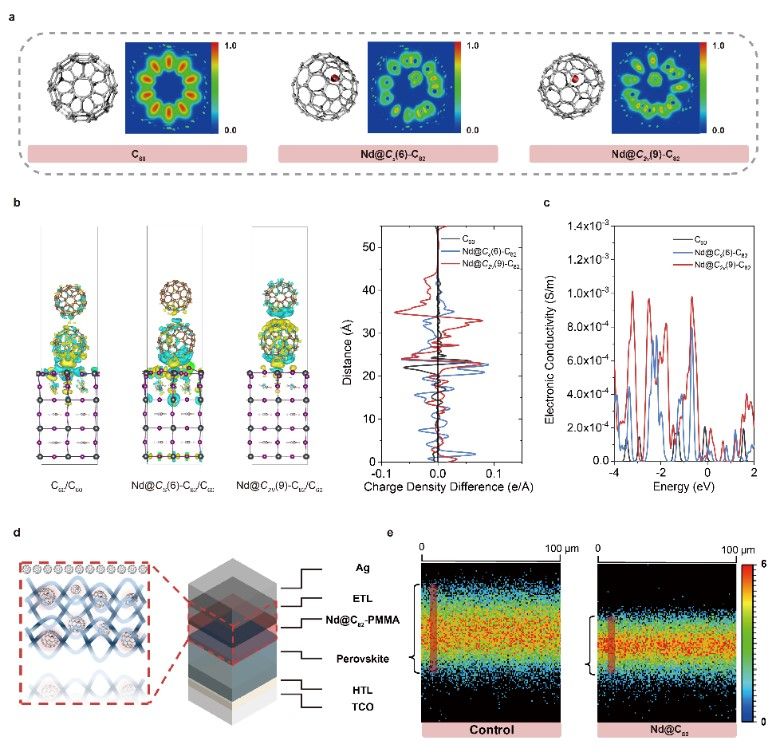
Figure 1: The coupled layer of embedded metal fullerene Nd@C₈₂ and polymethyl methacrylate (PMMA) facilitates ultrafast electron extraction and ion diffusion suppression
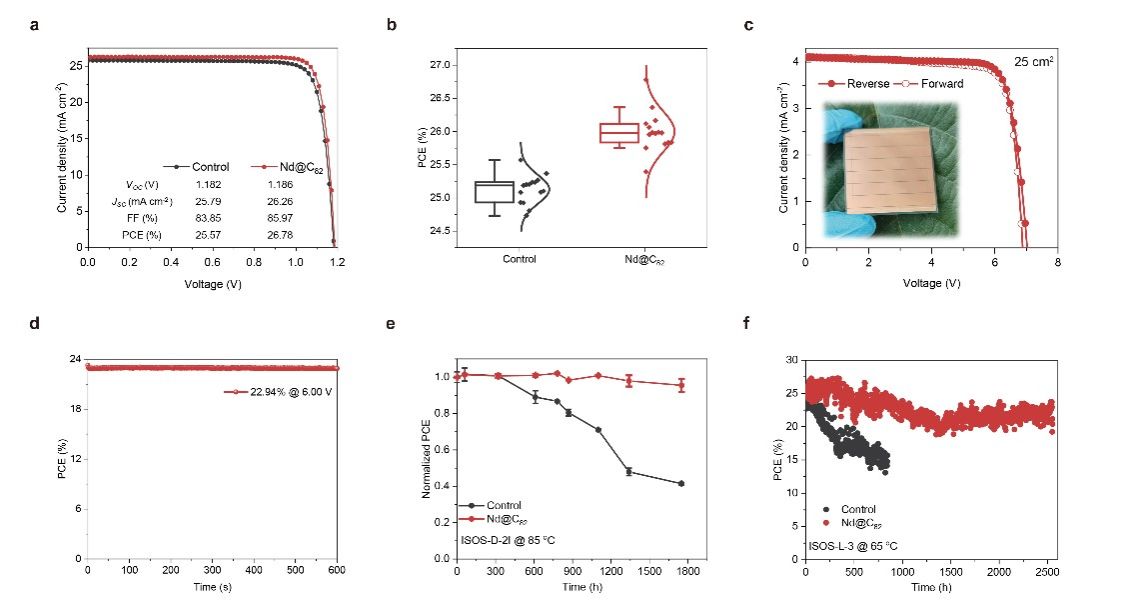
Figure 2: Photovoltaic performance of devices fabricated based on Nd@C₈₂
The corresponding authors of the paper are Professor LI Meng from HENU, Researcher LIANG Chao, Professor YANG Shengchun, and Researcher YANG Tao from the School of Physics, Xi’an Jiaotong University, Researcher CAI Wenting from the School of Chemistry, Xi’an Jiaotong University, and Professor XING Guichuan from the University of Macau. The co-first authors are doctoral students LIN Yuexin, SHUI Yuan, and ZHU Wenjing from the School of Physics, Xi’an Jiaotong University, graduate student LU Shili from the School of Chemistry, and Dr. LIN Zhichao from Fujian Agriculture and Forestry University. This research received support from the National Key Research and Development Program, the National Natural Science Foundation of China, the Young Top-notch Talent Support Program of Xi’an Jiaotong University, and the Fundamental Research Funds for the Central Universities, among other projects.
Article link:https://www.nature.com/articles/s41586-025-08961-9.
LI Meng is a professor and PhD supervisor of the School of Nanoscience and Materials Engineering, and a recipient of a National Young Talent Program Award. He serves as a young editorial board member for Applied Physics Letters under the American Institute of Physics (AIP), and is a council member of the Henan Chemical Society. He earned his Ph.D. from Soochow University in 2018 and subsequently worked as a postdoctoral researcher and visiting scholar at the Helmholtz-Zentrum Berlin for Materials and Energy in Germany, the École Polytechnique Fédérale de Lausanne (EPFL) in Switzerland, and the University of Cambridge in the UK. His research primarily focuses on semiconductor optoelectronic materials and devices, including perovskite solar cells and quantum dot light-emitting diodes. He has published over 40 papers as a corresponding author in academic journals such as Science, Nature, Nature Reviews Materials (Nat. Rev. Mater.), Nature Communications (Nat. Commun.), Advanced Materials (Adv. Mater.), Journal of the American Chemical Society (J. Am. Chem. Soc.), Angewandte Chemie (Angew. Chem.), and Science Bulletin (Sci. Bull.). His work has received over 7,600 citations with an h-index of 48. Funded by organizations such as the National Natural Science Foundation of China and the Henan Provincial Science Foundation, he has been leading several research projects.

 News /
Content
News /
Content